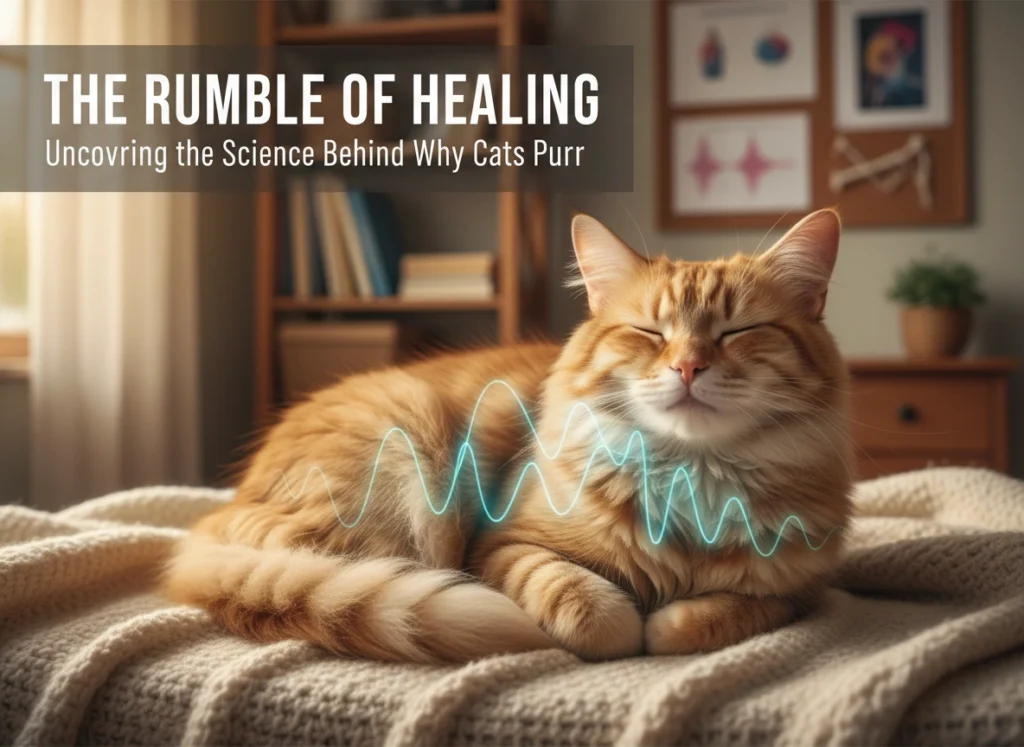
For centuries, the domestic cat has been a subject of fascination and mystery. From their worship in ancient Egypt to their domination of modern internet culture, felines have secured a firm place in human society. Yet, despite their ubiquity, one of their most defining characteristics remains somewhat enigmatic: the purr. This low, continuous rumble is often synonymous with a happy cat, but science reveals that the purr is far more complex than a simple expression of contentment. It is a sophisticated biological mechanism, a tool for communication, and surprisingly, a powerful instrument for self-healing.
To truly understand our feline companions, we must look beyond the surface of this soothing sound and explore the physiological and evolutionary reasons behind why cats purr.
The Physiology of the Purr: How Do They Do It?
The mechanics of purring have been debated by scientists for decades. Early theories suggested it was related to blood flowing through the inferior vena cava, but modern research has provided a clearer picture.
Currently, the most widely accepted theory is that purring originates in the cat’s brain. A neural oscillator sends rhythmic, repetitive signals to the muscles of the larynx (voice box) and diaphragm. As the cat breathes in and out, these muscles twitch at a rapid rate—specifically, roughly 20 to 30 times per second. This twitching causes the vocal cords to separate and close, regulating the airflow and creating that characteristic vibrational sound.
What makes purring unique among vocalizations is that it occurs during both inhalation and exhalation. Most vocal sounds, including human speech and the roaring of big cats, happen only when air is expelled. The cat’s ability to maintain a consistent sound frequency throughout the entire respiratory cycle suggests that purring is not just a passive sound but an active, continuous muscular effort.
Interestingly, not all cats can purr. The feline family is generally divided into “purring cats” (like house cats, bobcats, and cougars) and “roaring cats” (lions, tigers, leopards, and jaguars). The difference lies in the hyoid bone, located in the throat. In purring cats, this bone is rigid, allowing the vocal cords to vibrate appropriately. In roaring cats, the hyoid is flexible, which prevents purring but allows for terrifyingly loud roars.
Beyond Happiness: The Many Languages of the Purr
The common assumption is that a purring cat is a happy cat. While this is frequently true—your cat will often purr while being petted or fed—ethologists (scientists who study animal behavior) have observed purring in a variety of other, less pleasant contexts.
Cats have been observed purring while giving birth, when they are injured, while visiting the veterinarian, and even in the final moments of their lives. If purring were strictly an expression of joy, these scenarios would make no sense. This contradiction suggests that the purr serves multiple functions depending on the context.
The Solicitous Purr
One fascinating variation is what researchers call the “solicitation purr.” A study conducted by the University of Sussex revealed that cats can alter the frequency of their purr to manipulate their human owners. When demanding food, cats often embed a high-frequency cry within the lower purr. This cry falls into a frequency range similar to that of a human baby’s distress cry (around 300 to 600 Hz).
Humans are biologically hardwired to respond to this frequency. While a standard low-pitch purr is soothing, the solicitation purr is perceived as urgent and less pleasant, motivating the owner to address the cat’s needs—usually by filling the food bowl.
The Kitten-Mother Connection
Purring begins very early in a cat’s life, usually within a few days of birth. Kittens are born blind and deaf, but they can feel vibrations. The mother cat purrs to guide her kittens to her body for nursing. In return, the kittens purr while nursing to signal to the mother that they are feeding successfully and that milk supply is flowing. In this context, the purr acts as a vital homing beacon and a feedback loop for survival.
The Healing Frequency: Purring as Biological Therapy
Perhaps the most groundbreaking aspect of purring research is the discovery that it may function as an internal healing mechanism. This hypothesis centers on the specific frequencies at which cats purr.
Domestic cats typically purr at a frequency between 25 and 150 Hertz (Hz). This range is significant because it corresponds exactly with frequencies that have been shown in therapeutic medicine to improve bone density and promote healing.
Strengthening Bones and Muscles
Research into bioacoustics suggests that sound frequencies between 20 and 50 Hz can strengthen bones and help them grow. Frequencies in the higher range (up to 140 Hz) are beneficial for therapeutic pain relief and soft tissue healing.
Because cats spend a large portion of their day sleeping or sedentary—often up to 16 to 20 hours—they would theoretically be at risk for muscle atrophy and bone density loss, similar to complications faced by astronauts in zero gravity or bedridden hospital patients. Yet, cats rarely suffer from these issues. Scientists propose that purring acts as a form of “vibrational exercise.” By purring, a cat provides low-level stimulation to its muscles and bones, keeping them strong without expending the high energy required for physical activity.
Repairing Tissue and Reducing Pain
The concept of “purr therapy” extends to injury recovery. The vibrations caused by purring can stimulate the production of growth factors that repair tissue and reduce swelling. This may explain why injured cats often purr intensely. They are not expressing contentment; they are actively engaging a biological mechanism to soothe pain and accelerate their own recovery.
This self-healing theory is supported by veterinary anecdotal evidence, which often notes that cats tend to have fewer complications after surgeries compared to dogs, and generally have a higher survival rate after high-impact trauma (like falling from heights). The purr may be their built-in survival kit.
Emotional Regulation and Stress Relief
Just as humans might smile nervously or laugh during a tense situation to diffuse stress, cats may use purring as a self-soothing behavior. The act of purring releases endorphins in the cat’s brain. These neurochemicals act as natural painkillers and mood elevators.
When a cat is frightened—for example, at a veterinary clinic or in a new environment—purring helps them “calm down.” It lowers their blood pressure and regulates their breathing. This is a crucial distinction for cat owners to understand: a purring cat in a stressful environment is likely trying to comfort itself, not signaling that it is enjoying the experience.
This emotional regulation extends to social bonding. When two cats groom each other and purr, or when a cat purrs while rubbing against a companion, it reinforces social bonds and reduces aggression within the group. It is a signal of non-aggression, essentially saying, “I am not a threat, and I am comfortable with you.”
The Symbiotic Benefit: How the Purr Helps Humans
While the primary biological purpose of the purr is for the cat’s own survival and communication, the benefits spill over to their human companions. The symbiotic relationship between cats and humans has existed for thousands of years, and the purr plays a major role in that bond.
Studies have shown that cat owners have a 40% lower risk of heart attack than non-cat owners. While correlation does not always equal causation, the stress-reducing properties of interacting with a purr are undeniable. Sitting with a purring cat lowers human blood pressure and slows our heart rate. The vibrational frequency that heals the cat’s bones may also have a mild therapeutic effect on humans, offering a sense of calm and physical ease.
Conclusion: An Evolutionary Masterpiece
The cat’s purr is far more than a cute sound effect of domestication. It is an evolutionary masterpiece—a multitasking tool that serves as a communication device, a manipulation tactic, a stress reliever, and a biomechanical healing system.
Understanding the science behind the purr changes how we view our interactions with felines. When your cat curls up on your lap and begins to rumble, they are engaging in a complex physiological process. They might be telling you they are happy, they might be asking for dinner, or they might simply be keeping their bones strong for their next leap.
Regardless of the specific motivation, the result is the same: a profound connection between species, bridged by a frequency that heals, calms, and endures. The next time you hear that familiar hum, remember that you are listening to one of nature’s most sophisticated survival mechanisms at work.Please visit website for more info.
You may also read: Top 10 Unique Dog Names to Strengthen Your Bond with Your Pet
