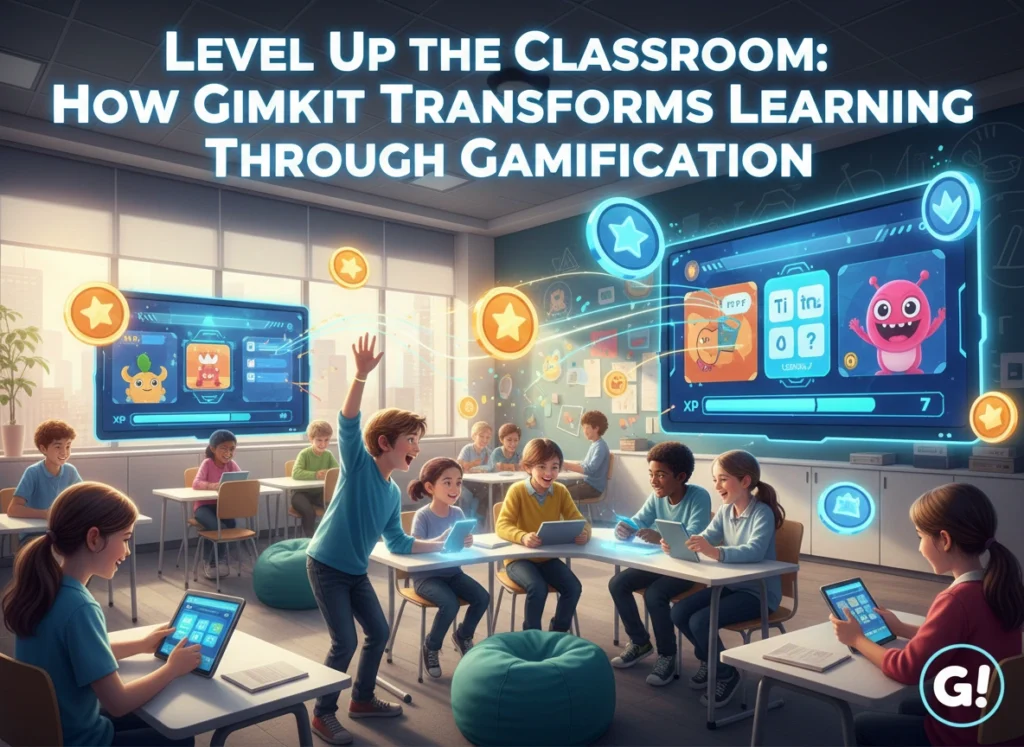
Traditional classroom instruction often hits a wall. Teachers stand at the front of the room, delivering crucial information, while students struggle to stay focused. It’s a challenge as old as education itself: how do we make learning stick? The answer for thousands of educators lies in gamification. Specifically, it lies in a platform designed by a high school student who experienced that boredom firsthand.
Gimkit is not just another quiz app. It is a dynamic learning tool that merges assessment with strategy, transforming passive review sessions into high-stakes, engaging competitions. This article explores how Gimkit leverages gamification to reshape the educational landscape, detailing its unique features, its profound impact on student engagement, and what its success signals for the future of EdTech.
The Power of Gamification in Education
Gamification isn’t about turning the classroom into an arcade. It is the strategic application of game-design elements—like point scoring, competition, and rules of play—to non-game contexts. The goal is simple: motivation.
When students play video games, they exhibit persistence, problem-solving skills, and intense focus. They don’t give up when they fail; they respawn and try again. Gamification attempts to capture that resilience and apply it to academic content. Instead of fearing failure, students view it as part of the learning loop. This shift is crucial. It changes a student’s mindset from “I have to learn this” to “I want to master this to win.”
What is Gimkit?
Gimkit was created by Josh Feinsilber as a high school project. He wanted to build a game he would actually want to play in class. Unlike standard multiple-choice quiz platforms like Kahoot! or Quizizz, Gimkit adds layers of economy and strategy.
In a typical Gimkit session, students answer questions on their own devices at their own pace. Correct answers earn them in-game virtual cash. Incorrect answers cost them money. This immediately introduces risk and reward. But the real magic happens in the “Shop.”
The Strategic Layer: The Shop and Upgrades
The core differentiator of Gimkit is its internal economy. Students don’t just accumulate points; they manage resources. With their earnings, they can purchase upgrades in the shop:
- Multiplier: Increases the amount of money earned per question.
- Streak Bonus: Rewards consistency by paying out more for consecutive correct answers.
- Insurance: Mitigates the penalty for wrong answers, encouraging students to take calculated risks.
This adds a layer of metacognition. A student must decide: Should I save my money for a big upgrade later, or buy a cheap one now to start earning faster? They are doing math and strategy simultaneously while reviewing their history or science content.
Key Features That Drive Engagement
Gimkit’s success is built on several game modes and features that prevent the experience from becoming stale.
Diverse Game Modes
The platform offers a variety of modes that change the objectives entirely:
- Classic Mode: Individuals compete to earn the most money within a time limit.
- Team Mode: Students collaborate, pooling their cash to reach a collective goal.
- Trust No One: Inspired by the popular game Among Us, students work to answer questions and remove “impostors” who are sabotaging the game.
- The Floor is Lava: A cooperative mode where the class must keep their collective money above a rising lava line.
These modes cater to different classroom dynamics. Some days require fierce individual competition, while others benefit from team-building exercises.
KitCollab
One of the most powerful features is KitCollab. This tool allows students to build the quiz themselves. Each student submits a question, and the teacher accepts or rejects them. Within minutes, the class builds a review game together. This shifts ownership of learning from the teacher to the students, forcing them to think critically about the material to formulate good questions.
Accessibility and Homework
Gimkit allows teachers to assign “Kits” as homework. Students can play through the modes asynchronously. Because the game is genuinely fun, homework compliance often increases. Students aren’t just filling out a worksheet; they are trying to beat their high score or unlock a new cosmetic item for their avatar.
Impact on Student Learning Outcomes
The flashy colors and excitement of Gimkit are great, but do they translate to learning? Evidence from classrooms suggests they do.
Repetition Without Boredom
Repetition is essential for memory retention, but rote memorization is tedious. Gimkit solves this by requiring students to answer questions repeatedly to earn money. A student might answer the same vocabulary question 10 or 15 times in a single 10-minute session. Because they are focused on the currency and upgrades, they don’t perceive it as drilling. They see it as “grinding” for resources—a familiar concept to any gamer.
Immediate Feedback Loop
In a traditional test, a student might wait days to see what they got wrong. In Gimkit, feedback is instantaneous. If a student answers incorrectly, the correct answer is shown immediately. Because they will likely see that question again in the same session, they are incentivized to memorize the correct answer instantly to avoid losing money next time. This tight feedback loop accelerates the correction of misconceptions.
Leveling the Playing Field
In many competitive classroom games, the smartest student always wins. This can demotivate the rest of the class. Gimkit’s power-ups change this dynamic. A student who may struggle with the content but understands strategy can use power-ups effectively to stay competitive. Furthermore, power-ups like the “Blue Shell” (which hurts the leader) or “Deflector” add an element of chaos that keeps the top students on their toes and gives others a fighting chance.
Gimkit in the Classroom: Real-World Examples
Teachers across various subjects utilize Gimkit to energize their lessons.
The Foreign Language Classroom
A Spanish teacher uses Gimkit for vocabulary acquisition. Instead of flashcards, students play “The Floor is Lava.” They must answer vocabulary translations correctly to keep their “construction” going and stay safe. The cooperative nature encourages stronger students to help those struggling, fostering a supportive community.
The Math Review
A math teacher uses the “Target Mode” for algebra review. The class must reach a collective bank balance of $10,000,000. Students solve equations on scratch paper before inputting answers. The teacher roams the room, not lecturing, but facilitating, helping students who are stuck on specific problems so they can get back in the game.
Science and Data Analysis
A biology teacher uses the game metrics after the session. Gimkit provides detailed reports showing which questions were missed most frequently. The teacher projects this data (anonymously) and uses the last 10 minutes of class to reteach specifically those concepts that stumped the class, ensuring targeted intervention.
The Future of Gamification and EdTech
Gimkit represents a maturation in educational technology. The first wave of EdTech was about digitization—putting worksheets on iPads. The current wave, led by tools like Gimkit, is about transformation. It acknowledges that student attention is the scarcest resource in the classroom and competes for it using the same psychological hooks as the entertainment industry.
The future of gamification likely involves even deeper integration of these mechanics. We can expect to see:
- Long-term Progression: Systems where student achievements carry over across the entire semester, creating a semester-long narrative or “campaign.”
- AI Integration: Tools that adapt questions in real-time based on student performance, ensuring the game is never too easy or too hard, maintaining the optimal “flow” state for learning.
- Cross-Curricular Games: Platforms where success in a math game might unlock resources for a history project, breaking down silos between subjects.
Conclusion
Gimkit transforms learning by meeting students where they are. It respects their desire for agency, excitement, and social interaction. By wrapping rigorous academic content in a layer of strategy and fun, it tricks the brain into welcoming repetition and feedback.
For educators, the takeaway is clear: we do not have to choose between rigorous learning and having fun. With the right tools, the classroom can be a place of joy and high achievement simultaneously. As we look toward the future of education, platforms like Gimkit prove that when learning feels like play, everyone wins.
