The world of finance often feels like it is built behind a wall of impenetrable jargon. Terms like “derivatives,” “short-selling,” and “amortization” can make even the most diligent saver feel out of their depth. Among these complex terms sits one that gained infamy during the 2008 financial crisis but remains a fundamental building block of modern investing: the tranche.
While the word sounds technical—borrowed from the French word for “slice” or “portion”—the concept itself is surprisingly intuitive once you strip away the Wall Street terminology. Understanding tranches isn’t just an academic exercise for finance majors. It is crucial for anyone who wants to understand how large-scale lending works, how risk is managed in the global economy, and how different investment products are structured to suit different types of investors.
This article will peel back the layers of complexity surrounding tranches. We will explore what they are, how they work in the real world (particularly in mortgage-backed securities), and why they matter. By the end, you will see that a tranche is simply a way of organizing who gets paid first and who takes on the most risk.
What Exactly Is a Tranche?
At its core, a tranche is a specific slice of a pooled collection of securities. When banks or financial institutions lend money—whether for mortgages, car loans, or credit card debt—they often don’t hold onto that debt forever. Instead, they bundle hundreds or thousands of these loans together into a single package.
However, not all investors want the same thing. Some are conservative; they want safety above all else and are willing to accept lower returns for peace of mind. Others are aggressive; they are willing to gamble on higher risks if it means the potential for a bigger payout.
This is where tranches come in. Instead of selling the bundle of loans as a single, uniform product, the financial institution slices it up into different layers, or tranches. Each tranche has different rules regarding:
- Risk: How likely you are to lose your money.
- Reward: The interest rate or return you receive.
- Maturity: When you get your principal investment back.
Think of it like a waterfall. Imagine money flowing down from the top. The investors at the top get to drink first. The investors in the middle drink next. The investors at the bottom only get what is left over. Because the people at the bottom risk going thirsty, they demand a much bigger reward if the water keeps flowing.
The Hierarchy of Risk and Reward
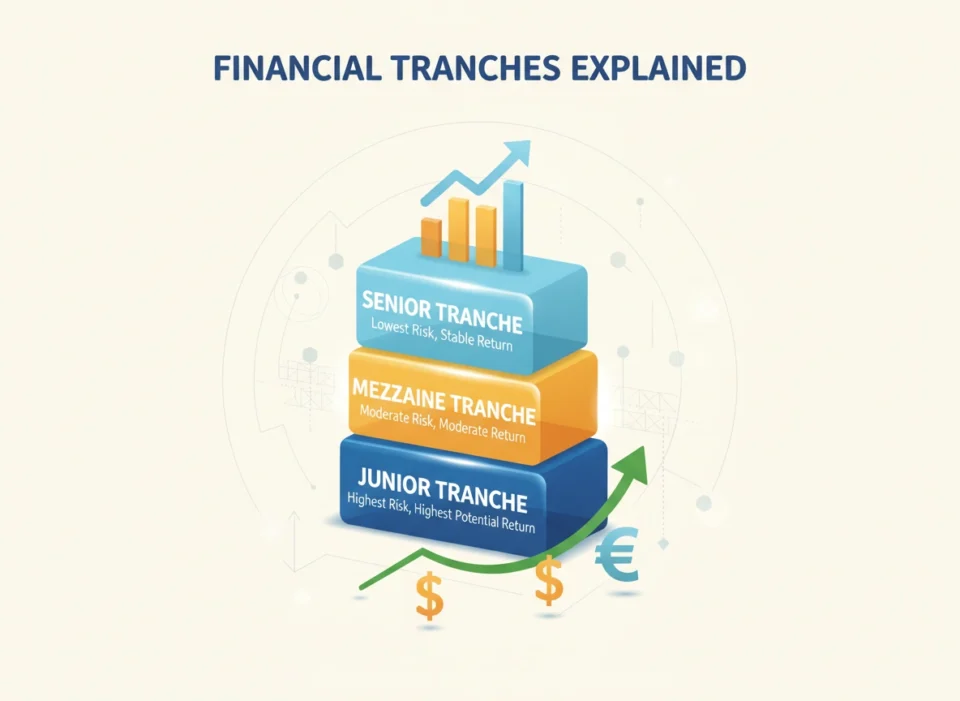
To fully grasp how this works, we need to look at the standard hierarchy of tranches. While specific deals can be complex, they usually follow a three-tier structure:
1. The Senior Tranche (The Safe Haven)
This is the top of the waterfall. Investors who buy into the senior tranche are the first to be paid back from the cash flow generated by the underlying loans. Because they have “first dibs” on the money, their investment is considered very safe. Even if some people in the pool of loans default (stop paying), there is usually enough money flowing in to cover the senior investors.
- Risk: Lowest.
- Return: Lowest (but generally higher than government bonds).
- Credit Rating: Often AAA or AA.
2. The Mezzanine Tranche (The Middle Ground)
“Mezzanine” comes from the Italian word for “middle.” These investors stand in the middle of the waterfall. They only get paid after the senior tranche has received its full share. If defaults rise, the mezzanine tranche starts to feel the pain before the senior tranche does, but after the equity tranche.
- Risk: Moderate.
- Return: Moderate.
- Credit Rating: BBB to A.
3. The Junior or Equity Tranche (The High-Risk Gamblers)
This is the bottom of the waterfall. These investors are the last to get paid. If a significant number of borrowers default on their loans, the equity tranche is the first to lose money. In fact, they absorb the losses for everyone else. If the losses are small, they just earn less. If losses are high, their entire investment can be wiped out before the mezzanine or senior investors lose a single penny. Because they provide this “protection” to the upper layers, they demand a very high interest rate.
- Risk: Highest.
- Return: Highest.
- Credit Rating: Unrated or “Junk” status.
Real-World Example: Mortgage-Backed Securities (MBS)
The most common place you will encounter tranches is in Mortgage-Backed Securities (MBS). Let’s build a hypothetical scenario to illustrate how this functions in the real economy.
Imagine a bank issues $100 million worth of mortgages to 500 different homeowners. The bank wants to free up its cash to lend to more people, so it packages these 500 loans into a security called an MBS.
Investors want to buy this debt to earn the interest payments homeowners make every month. But not every investor trusts that all 500 homeowners will pay.
The bank splits the $100 million MBS into three tranches:
- Tranche A (Senior): $80 million worth of the deal. Pays 3% interest.
- Tranche B (Mezzanine): $15 million worth of the deal. Pays 6% interest.
- Tranche C (Equity): $5 million worth of the deal. Pays 12% interest.
Now, let’s look at two scenarios:
Scenario 1: Smooth Sailing
Every homeowner pays their mortgage on time. The bank collects the payments and distributes them. Tranche A gets their safe 3%, Tranche B gets their 6%, and Tranche C enjoys a massive 12% return. The risk paid off for the equity investors.
Scenario 2: Economic Downturn
A recession hits, and 4% of the homeowners default. That is a loss of $4 million.
- Who pays for this loss? The loss is absorbed entirely by Tranche C.
- Since Tranche C is worth $5 million, and the loss is $4 million, the equity investors lose 80% of their principal.
- Tranche B is completely untouched. They still get their full interest and principal because Tranche C acted as a buffer.
- Tranche A doesn’t even feel a bump in the road.
Scenario 3: Market Crash
A severe crisis hits, and 10% of homeowners default ($10 million loss).
- Tranche C is completely wiped out ($5 million loss).
- The remaining $5 million loss eats into Tranche B. Since Tranche B is worth $15 million, they lose a third of their investment.
- Tranche A is still safe. The losses haven’t reached the top of the waterfall yet.
This example illustrates why senior tranches are rated so highly by credit agencies—it takes a catastrophic level of default to reach them. Conversely, it shows why junior tranches are speculative; a small uptick in defaults can destroy their value.
Why Are Tranches Necessary?
You might wonder, “Why make it so complicated? Why not just sell the loans as they are?”
Tranching solves a fundamental problem in finance: matching supply with demand.
If the bank sold the $100 million bundle as one flat product with an “average” risk and an “average” return, they would struggle to find buyers. Pension funds and insurance companies are often legally required to hold only the safest (AAA-rated) investments. They couldn’t buy an “average” product because it contains too much risk. On the other hand, hedge funds seeking high returns wouldn’t buy it because the “average” yield is too low.
By slicing the debt into tranches, the bank creates a product for everyone:
- Pension Funds buy the Senior Tranche.
- Regular Investment Funds buy the Mezzanine Tranche.
- Hedge Funds buy the Equity Tranche.
This process essentially creates “safe” assets out of risky loans. By isolating the risk into the bottom layer, the top layer becomes secure enough for conservative investors.
The Risks and Criticisms
While tranches are useful tools for distributing capital, they are not without controversy. Their complexity can sometimes mask the true risk of an investment.
During the 2008 financial crisis, banks created Collateralized Debt Obligations (CDOs), which were essentially tranches of tranches. They took the mezzanine slices (the middle risk) from various mortgage securities and repackaged those into new securities.
Credit rating agencies gave the top layers of these new creations AAA ratings, implying they were as safe as government bonds. However, because the underlying loans were often subprime (high risk), when the housing market collapsed, the defaults were so widespread that they flooded the waterfall. The “safe” senior tranches were wiped out alongside the risky ones.
This highlighted a critical lesson: Tranching can redistribute risk, but it cannot eliminate it. If the entire pool of loans is toxic, slicing it up doesn’t make it safe—it just obscures the danger.
Summary
Understanding tranches is like learning the grammar of modern finance. It allows you to read the sentences rather than just staring at the words.
Here are the key takeaways to remember:
- Definition: A tranche is a slice of a pooled investment that allows investors to choose their preferred level of risk and reward.
- Structure: They usually follow a hierarchy (Senior, Mezzanine, Junior/Equity).
- The Waterfall: Money flows to the top first; losses hit the bottom first.
- Utility: They allow different types of investors (from conservative pension funds to aggressive hedge funds) to participate in the same market.
- Caution: While they structure risk, they do not remove it. If the underlying asset is bad, the structure will eventually fail.
For a beginner, the concept of tranches demystifies how big banks handle debt. It shifts the perspective from a simple “borrower and lender” dynamic to a sophisticated system of risk management and distribution. Whether you are looking to invest in complex securities one day or simply want to understand the headlines during the next economic shift, knowing your Senior from your Equity tranche is an invaluable piece of financial literacy.Please click here for more info.
You may also read: Top 10 Unique Dog Names to Strengthen Your Bond with Your Pet
