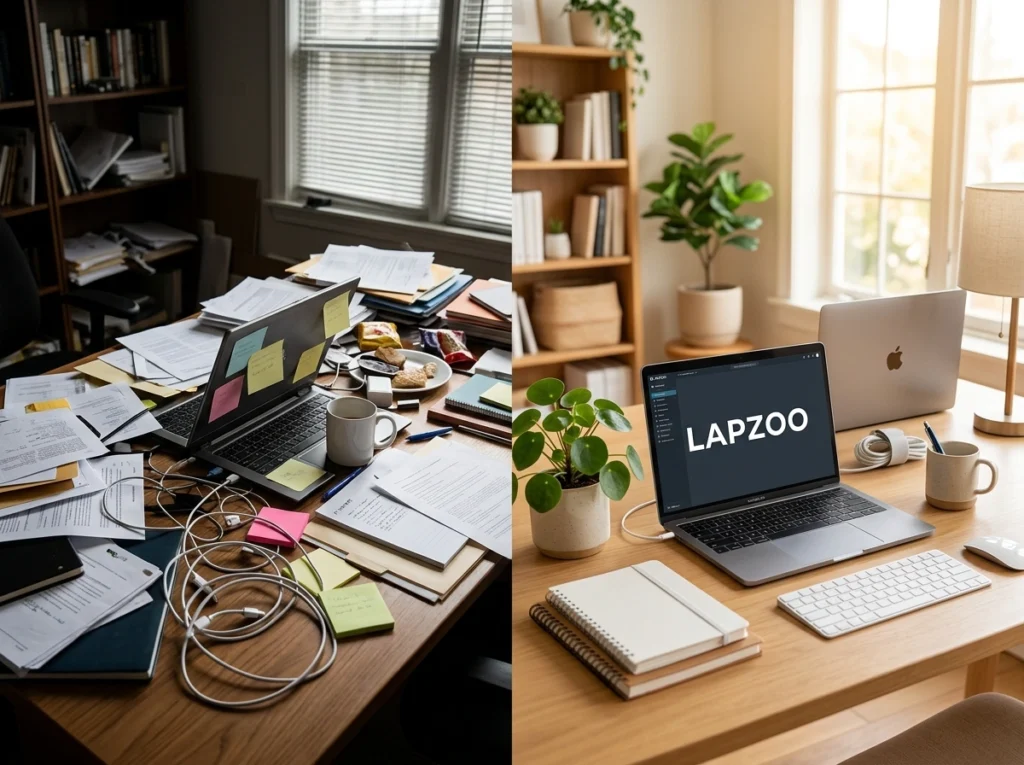
My desk used to look like a tornado hit it. Coffee mugs, tangled cables, sticky notes I couldn’t read, and a laptop balanced on a stack of old magazines. Sound familiar? If your workspace feels more like a junk drawer than a place to get things done, you’re not alone. I decided to fix mine for good, and I gave myself 30 days to do it.
Here’s what you’ll get from this post:
- An honest look at my cluttered starting point
- A week-by-week breakdown of my progress with Lapzoo
- The features that actually made a difference
- My final verdict and whether I’d recommend it
Let me walk you through the whole journey.
Where I Started: A Workspace Out of Control
I work from home most days, splitting my time between a small home office and my couch. The problem? I never had a real setup for either. My laptop overheated on the bed. My back ached from hunching over the coffee table. And my desk drowned under a pile of stuff I kept meaning to sort “later.”
The clutter wasn’t just ugly. It slowed me down. I’d lose 10 minutes hunting for a charger or clearing space just to start working. Studies show a messy workspace can hurt focus and raise stress, and I felt every bit of that.
I knew I needed something flexible. Something that worked at my desk, on the couch, and in bed without taking over my whole apartment. That search led me to lapzoo.
Discovering Lapzoo
I stumbled across Lapzoo while scrolling for portable desk solutions late one night. What caught my eye was the focus on adaptability. It wasn’t just another bulky desk. It promised a clean, organized surface that moved with me, plus built-in storage to corral all my random gear.
I was skeptical. I’d bought “organization” products before that ended up adding to the mess. But the 30-day window felt like the perfect test. If it could survive a month in my chaotic routine, it could survive anything.
So I ordered it and committed to using it daily for four weeks. Here’s how it went.
Week-by-Week: My 30-Day Journey
Week 1: Getting Set Up
The first few days were about breaking old habits. I cleared my desk completely, which honestly felt great on its own. Then I set up my new station and gave everything a home.
The biggest early win was the dedicated space for my laptop, phone, and a notebook. No more juggling. By day five, I noticed I wasn’t hunting for things anymore. Small change, big relief.
Takeaway: A clean slate plus a designated spot for each item makes a noticeable difference fast.
Week 2: Building Routine
Week two is when habits started to stick. I began ending each workday with a quick two-minute reset, putting everything back in its place. It sounds simple, but it kept the clutter from creeping back.
I also started moving my setup between the office and the living room. The portability made this easy. I could work at my desk in the morning, then shift to a more comfortable spot in the afternoon without losing my organization.
Takeaway: Consistency beats intensity. A short daily reset kept my whole system on track.
Week 3: Noticing Real Benefits
By the third week, the changes went beyond a tidy surface. My posture improved because I finally had a stable, properly positioned workspace. The laptop ran cooler since it wasn’t trapped on a blanket. And my focus sharpened in a clutter-free environment.
I tracked my work hours that week and found I was getting more done in less time. Fewer distractions meant fewer reasons to step away from my tasks.
Takeaway: Organization isn’t just about looks. It directly affects comfort, focus, and output.
Week 4: Locking It In
The final week felt automatic. My reset routine was second nature, and my workspace stayed clean without effort. What started as a forced experiment had turned into a genuine habit.
I even invited a friend over who immediately commented on how put-together my space looked. That outside reaction confirmed what I already felt: the transformation was real.
Takeaway: Give a good system three to four weeks and it stops feeling like work and starts feeling normal.
The Features That Actually Mattered
Not every feature wowed me, but a few earned their keep over the month. Here’s what stood out:
- Portability: Moving between rooms without disassembling anything was a game changer for my flexible work style.
- Built-in storage: Having a spot for cables, pens, and small gear kept the surface clear and my mind clearer.
- Stable, comfortable surface: A flat, steady workspace fixed my posture problems and kept my laptop running cooler.
- Simple design: It blended into my home instead of dominating it, which mattered in a smaller living space.
The combination of these features, not any single one, is what made the difference. It addressed the root of my clutter problem rather than just hiding it.
Mistakes I Avoided (And You Should Too)
If you’re starting your own organization journey, learn from a couple of things I got right by accident:
- Don’t skip the full reset. Clearing everything at the start gave me a true clean slate. Half-measures keep old clutter habits alive.
- Don’t ignore the daily routine. The two-minute reset was the secret weapon. Without it, even the best setup gets messy again.
- Don’t expect overnight change. It took a couple of weeks for the habits to feel natural. Stick with it.
My Final Verdict
After 30 days, my answer is clear: it worked. My workspace went from a daily source of frustration to something I actually enjoy sitting down at. My focus improved, my back feels better, and I stopped wasting time digging through clutter.
Was it a magic fix? No. The product gave me the structure, but the daily habits did the heavy lifting. The two worked together. If you’re someone who works in multiple spots, struggles with a messy desk, or just wants a more comfortable setup, this is worth a serious look.
The 30-day window is what convinced me. It’s enough time to build a real habit and see if the change sticks. For me, it absolutely did.
Ready to Clear Your Own Clutter?
If your desk is buried and your focus is suffering, you don’t have to live with it. Start with a full reset, give every item a home, and build a simple daily routine to keep it that way. A tool like Lapzoo can give you the structure to make those habits last.
Which step are you starting with first? Pick one today, and your future self will thank you in 30 days.
